
#10Gbps #Routers #Mesh #Systems
This post features the top five 10Gbps routers and Wi-Fi systems that I’ve evaluated. And 10Gbps is currently the highest wired bandwidth available for any home or small business—you could even call it “overkill.”
I’ve used all of these devices for an extended period—from over a month to over a year—with my 10Gbps Sonic Fiber-optic plan, and I’m still using some of them right now at various locations with multi-gigabit broadband. That’s to say they are really the top among their peers.
Dong’s note: I first published this post on May 2, 2024, and last updated it on November 11, 2025.

Top five best 10Gbps routers and Wi-Fi systems: The lists
A few things to keep in mind:
- There are two lists: one for standalone routers and the other for canned mesh systems. Most of the routers mentioned here can function as mesh members, and all the router units of the mesh systems mentioned here can operate as standalone routers.
- To qualify for this list, the bare minimum is that the hardware must have at least two 10Gbps ports—one for the WAN side and the other for the LAN. With the help of a 10Gbps switch and proper wiring, the entire home will have the highest possible bandwidth.
- These lists are sorted in recommendation order—the numbers are the ranking, with the number one being the best in my experience for my needs.
Notes on 10Gbps hardware
A router needs more than just a couple of 10Gbps Ethernet network ports to deliver (close to) true 10Gbps. It also requires high processing power and applicable firmware to handle this bandwidth.
Generally, consumer-grade Multi-Gig routers and switches do not deliver true 10Gbps (10,000Mbps) throughputs. After “overhead”, they sustain approximately between 6.5Gbps (Wi-Fi 6/6E hardware) and 9Gbps (Wi-Fi 7 hardware). Often, a router’s traffic-related features, such as QoS, security, etc., when turned on, can impact its bandwidth.
Many home Wi-Fi routers support the entry-level Multi-Gig, which is 2.5Gbps and can deliver close to 2,500Mbps in real-world speeds.
As usual, you should check each device’s full review to see how it pans out in detail, but if you’re in a hurry, any of them will do you a solid. Note that none of these routers will give you the actual 10Gbps performance in real-world usage, but they are indeed the fastest possible among consumer-grade options after overhead.
Let’s start with the routers.
Best 10Gbps routers: The ultimate list of top performers (and alternatives)
There are dozens of 10Gbps-capable routers on the market that I’d consider great, and picking only five out of them is challenging. That said, when applicable, I’ll include comparable alternatives worthy of your consideration. So, consider these five the representatives of their peers.
5. NETGEAR Nighthawk RS700S: 2x 10GBASE-T

The Nighthawk RS700S is NETGEAR’s first standalone router with two Multi-Gig ports—both are 10GBASE-T. Despite its markedly different design, it has virtually the same hardware specs as the ASUS RT-BE96U.
It’s the least recommended on this list due to its neutered web user interface. The omission of the standard and widely used web-based remote access feature alone is a deal-breaker for many advanced users. In fact, that was the reason I stopped using it after a month.
It’s also the sole router on this list that’s not mesh-capable—it works well only for homes where a single broadcaster is sufficient. Still, if you have 10Gbps broadband, the NETGEAR RS700S has enough to make you happy.
Tip
Technically, all Wi-Fi devices are transceivers, as they can both transmit and receive wireless signals. However, in the context of a local network, you can think of a Wi-Fi access point (or a router) as the “broadcaster”, as it’s subject to regulatory “broadcasting power” and can host multiple “receivers”, also known as Wi-Fi clients or devices, simultaneously. The term is only to demonstrate their roles, and not to omit the fact that networking is two-way communication.
Pros
Top-tier tri-band specs with Wi-Fi 7 support
Two 10Gbps Multi-Gig ports
Robust web interface, helpful (optional) mobile app
Practical fanless design; runs cool and quiet
Cons
Only two Multi-Gig ports; no standard Remote Management via Dynamic DNS
Online protection and Parental Controls require the Nighthawk mobile app and premium subscriptions
4. TP-Link Archer GE800: 1x 10GBASE-T, 1x 10GBASE-T/SFP+ combo, 4x 2.5GBASE-T
The Archer GE800 is TP-Link’s first actual gaming router. It’s a powerhouse with 7 specs of top-tier Wi-Fi and a multi-Gigabit approach, including two 10Gbps and four 2.5Gbps ports. This Wi-Fi machine is arguably the best standalone router TP-Link has ever made.
Similar alternatives:
Need to make a quick shopping decision? Compare their prices on Amazon!
Pros
Top-tier tri-band Wi-Fi 7 specs with full multi-Gigabit to deliver excellent real-world performance
Robust web user interface with an excellent set of network features and Wi-Fi settings, including MLO and gaming-related features
Competitively priced; useful (optional) mobile app; EasyMesh-ready; cool-looking design
Cons
Bulky design with an audible internal fan; runs hot; Wi-Fi throughputs could be comparatively a tad better
No AFC; online protection and advanced parental controls require subscriptions
3. UniFi Dream Machine Pro Max (UDM Pro Max): The ultimate full-scale rackmount non-Wi-Fi router
The UDM Pro Max is a home-friendly, full-scale, non-Wi-Fi router designed for those with a network rack. With two 10Gbps ports, one 2.5Gbps port, and numerous Gigabit PoE ports, it’s ready to host a wide range of devices. The console also features two hard drive bays to accommodate terabytes of RAID1-protected storage space for its other functions.
Alternatively, you can also consider the similar UDM-SE, which has slightly lower hardware specifications and only a single drive bay.
Pros
Robust hardware to handle large-scale networks via multiple simultaneous enterprise-class applications; excellent overall performance
A complete set of useful networking features, including powerful security/web-filtering and WireGuard VPN; excellent web user interface; useful mobile apps
Dual drive support with RAID 1; no subscription required; runs relatively cool and quiet
Cons
Bulky design with only two SFP+ (10Gbps) and one 2.5GBASE-T ports, no 10GBASE-T port, no PoE support
A Ubiquiti login account is required for some useful features to work
2. ASUS GT-BE19000AI: 2x 10GBASE-T and 4x 2.5GBASE-T
The GT-BE19000AI is arguably ASUS’s best Wi-Fi 7 router. Despite a similar design to previous ASUS ROG gaming routers, such as the GT-BE98 Pro or the GT-AX11000 Pro, it’s a totally different beast thanks to support for Edge AI and Docker hosting. Other than that, it has multiple Multi-Gig ports, tons of gaming features, and uncompromising Wi-Fi 7 support.
Like all ASUS routers, you can use multiple GT-BE19000AI units to build a formidable AiMesh Wi-Fi system.
Similar alternative:
Not sure which to pick between the above? Compare availability on Amazon!
Pros
Top-tier Wi-Fi 7 with excellent real-world performance
Refined ASUSWRT 6.0 firmware with lots of free, in-depth, and valuable features and settings (advanced VPN, AiProtection online protection, Parental Control, adblocking, virtual SSDs, AI-enabled gaming-related features, and AiMesh)
Two 10Gbps and four 2.5Gbps Multi-Gig ports with WAN/LAN flexibility; supports Dual-WAN and LAN Link Aggregations
No vendor required login account, silent performer, runs relatively cool
Cons
Bulky design, buggy Docker support (at launch), not wall-mount-ready
AFC unavailable (at launch)
1. Ubiquiti UniFi Cloud Gateway Fiber (UCG-Fiber): 1x 10GBASE-T, 2x SFP+, 4x 2.5GBASE-T

Like the UDM Pro Max above, UniFi Cloud Gateway Fiber is a non-Wi-Fi router. You can add one or a couple of UniFi access points to create a robust mesh system.
The UCG-Fiber has two SFP+ ports, one 10GBASE-T port, and four 2.5GBASE-T ports, making it one of the most generous Multi-Gig routers, port-wise. It can handle a multi-Gigabit Dual-WAN setup while maintaining a 10Gbps local connection right out of the box.
Most importantly, it offers the most features and in-depth customization, yet comes with a well-thought-out management system that makes all users happy, from home to enterprise-class.
Similar alternatives:
Need help deciding between these four? Check availability on Amazon!
Pros
Top-tier hardware with three 10Gbps ports, four 2.5GBASE-T ports, PoE+ support, and an NVMe slot for NVR
Excellent and reliable real-world performance; can handle lots of concurrent UniFi devices (Wi-Fi access points, cameras, IP phones, etc.) and end-users
Compact and aesthetically pleasing design with everything for all users, from home to enterprise-grade
Lots of valuable features, each with tons of customization, comparatively affordable
Cons
Only one PoE+ port, no PoE++ support; SFP+ ports are less practical than 10GBASE-T
A Ubiquiti login account is required for the built-in Remote Management, as well as some other useful features, to work
Runs a bit warm, no SSD caddy is included in the non-storage version; no USB port or network-attached storage features
Best 10Gbps Wi-Fi systems: The current list of top performers
Currently, there are fewer than 10Gbps-capable mesh systems on the market than standard routers. That said, the list below includes all those that qualify. Not all of them are better in terms of features and privacy than when you get a couple of mesh-capable routers on the list above together. Still, on the wired networking front, they are all formidable contenders that will give you the best performance currently available.
5. NETGEAR Orbi 970 series (Wi-Fi 7): 2x 10GBASE-T + 4x 2.5GBASE-T (router) / 1x 10GBASE-T + 2x 2.5GBASE-T (satellite)

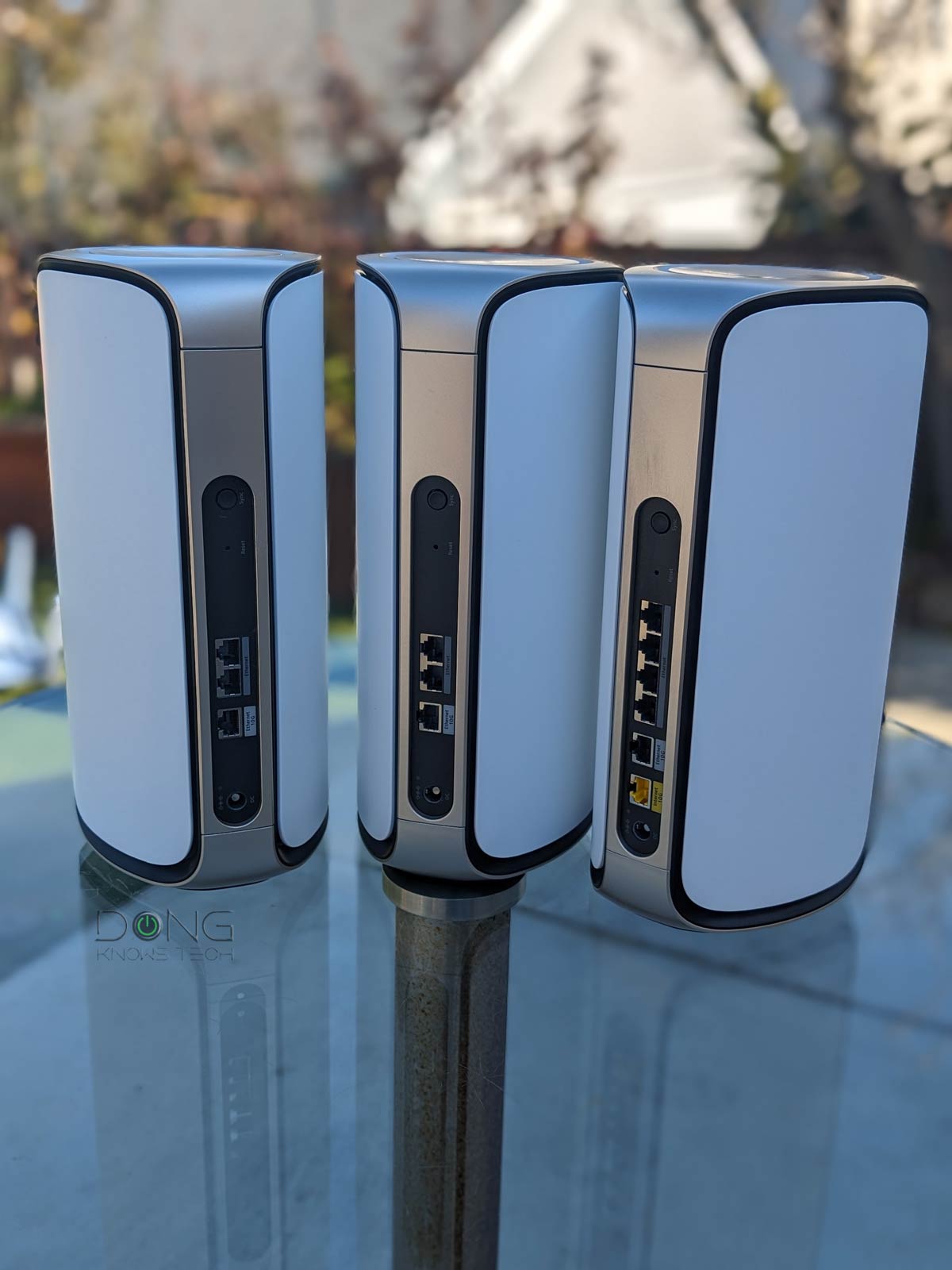
The 970 series is NETGEAR’s latest Orbi mesh set and also the company’s first canned system to feature Wi-Fi 7 and full Multi-Gig. The hardware does not have a Gigabit port. Unfortunately, unlike the TP-Link BE85 below, the satellite unit has only one 10Gbps port, meaning you’ll need a switch before you can get a true 10Gbps wired backhauling system with it.
Pros
Powerful hardware with quad-band Wi-Fi 7 with all-Multi-Gig ports
Fast performance, extensive coverage, with excellent wireless backhaul bandwidth
Multi-Gigabit wired backhauling support; easy to use; runs cool and quiet
Cons
Unreasonably expensive; the permanent 5GHz backhaul band is unavailable to clients in a wired backhaul setup
No web-based Remote Management, limited Wi-Fi and network settings, few free features; mobile app (with a login account and even subscriptions) is required to be useful
No 2nd 10Gbps port on the satellite; unreliable (at launch); no USB port; lots of upselling pop-ups
4. TP-Link Deco BE85 (Wi-Fi 7): 2x 10GBASE-T and 2x 2.5GBASE-T
The Deco BE85 forgoes Gigabit ports altogether. Instead, it comes with two 10GBASE-T ports (one is an SFP+/RJ45 combo) and two 2.5GBASE-T ports. With them, this 3-pack mesh is the best-performing Wi-Fi solution to date via wired backhauling.
Alternatively, you can also consider the Deco BE95.
Pros
Four Multi-Gig ports, including two 10 Gbps, one of which supports RJ45/SFP+ combo; multi-Gigabit wired backhauling out of the box
Wi-Fi 7 support, backward compatible with existing clients; excellent overall real-world performance
Cons
The performance of the 2.4 GHz band and 10Gbps ports could be better
Vendor-connected mobile app required; HomeShield Pro costs extra
Internal fan; runs a bit hot
3. ASUS ZenWiFi BT10 (Wi-Fi 7): 2x 10GBASE-T


The ZenWiFi BT10 is the tri-band version of the BQ16 Pro below and the second in the family to feature Wi-Fi 7. This 2-pack mesh had a rough start when it was first launched in July 2024. It wasn’t until November that a well-developed version of firmware was available to make it a formidable alternative to its superior cousin.
If you have a wired home, this is an excellent Wi-Fi 7 upgrade.
Pros
Tri-band Wi-Fi 7 with two 10Gbps ports and excellent performance
ASUSWRT 5.0 has lots of customizations and free-for-life high-end features (VPN, Parental Controls, Online Protection, Dual-WAN, Link Aggregation, Smart Home Master, etc.).
Robust web user interface and helpful optional mobile app; easy-to-blend-in design
Comparatively compact with no internal fan; runs cool and quiet
Cons
No AFC (at launch); not wall-mount-ready
2. ASUS ZenWiFi BQ16 Pro (Wi-Fi 7): 2x 10GBASE-T


The ZenWiFi BQ16 Pro is the first in ASUS’s ZenWiFi family to support Wi-Fi 7. Most importantly, it’s also the first to deliver Wi-Fi 7 in all its glory, including the fact that it’s the first to support the AFC feature and be the most powerful canned mesh system to date.
The new mesh system is available in packs and two or three units with a single unit option to come. Each unit can work as a standalone router.
Pros
Top quad-band Wi-Fi 7 specs with all features to deliver best-to-date real-world performance both in throughputs and coverage; two 10Gbps Multi-Gig ports
The latest ASUSWRT 5.0 has lots of customizations and free-for-life high-end features (VPN, Parental Controls, Online Protection, Dual-WAN, Link Aggregation, Smart Home Master, etc.).
Robust web user interface and helpful optional mobile app; easy-to-blend-in design
Comparatively compact with no internal fan
Cons
Comparatively expensive; numerous settings require a lengthy restart to apply
Only two Multi-Gig ports; AFC still pending certification (by late 2025)
1. Ubiquiti UniFi-based Wi-Fi system: 2x SFP+, (1x 10GBASE-T,) and multiple 2.5Gbps ports
A UniFi-based mesh Wi-Fi system is not available as a “canned” solution. You’ll need to start with a 10Gbps-capable gateway, such as:
and then add a couple or more 10Gbps-capable UniFi access points, such as:
to build a system. In return, it’ll give you the most robust network with the best performance and top-notch feature set.
Pros
Excellent and reliable performance with seamless support for UniFi hardware of multiple categories (Network, Protect, Talk, Access, etc.)
Tons of helpful networking features, a comprehensive web user interface, and a mobile app
Practical and aesthetically pleasing hardware design, no vendor account required
Cons
No AP mode as a system, most Wi-Fi-integrated consoles can only work in the primary router role
Some helpful features (teleport VPN, automatic backup, convenient remote access, etc.) require a vendor-connected login account
Default Wi-Fi settings heavily favor compatibility and reliability over fast real-world performance
The takeaway
“Money is not an issue. Just tell me the best router/mesh system to buy!” is the request I often receive—if only it were that easy.
Networking, whether in real life or technology, is always a matter of nuance, and individual needs vary significantly. In most cases, you need to figure that out first, and only then will money help.
However, if you have 3Gbps or faster broadband, any of the hardware options above will yield the best real-world performance, at least at the router unit and especially via a wired connection. If you’re still not happy, check your device or maybe your expectations first.


Recent Comments